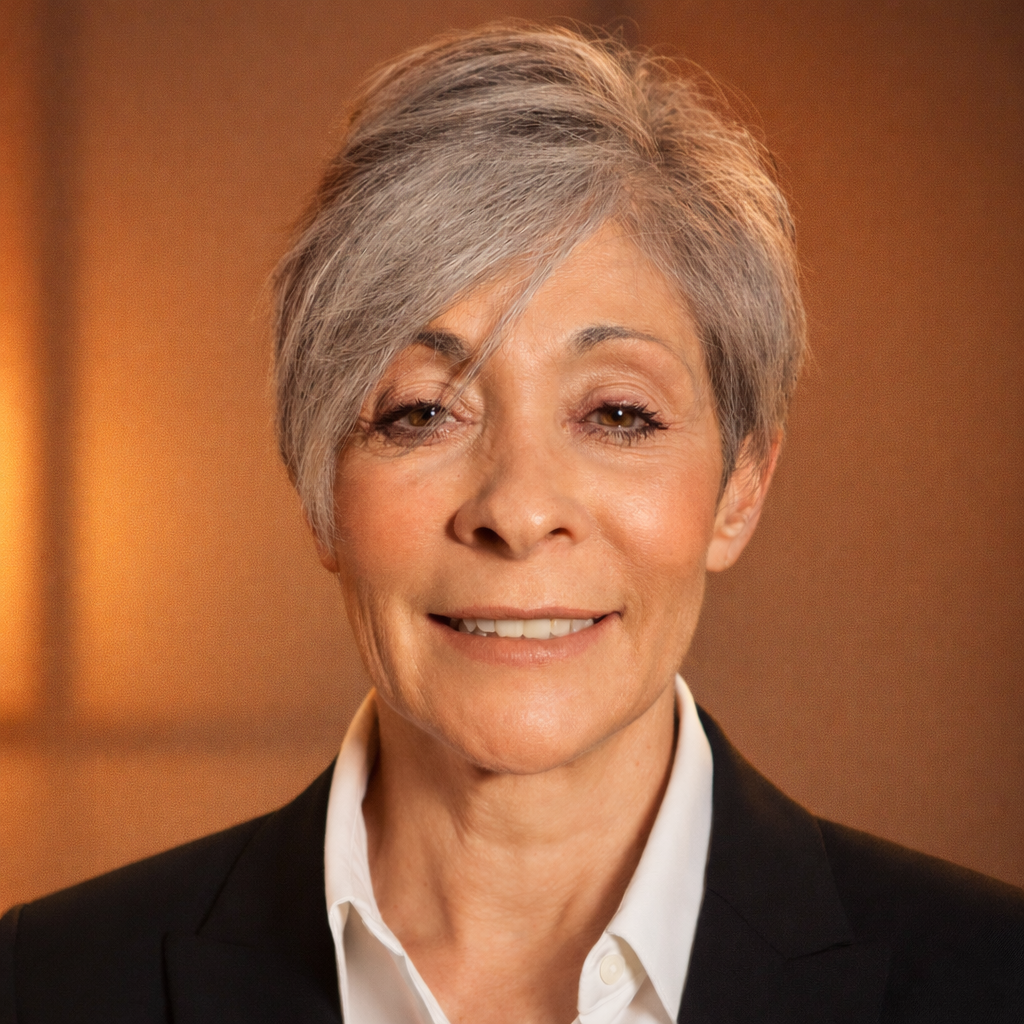
Short Biography
Dr. Ana María Merico-Stephens is Professor Emerita of Constitutional Law at the University of Arizona (tenured 2004, retired 2016) and a Fulbright Senior Scholar. Diagnosed autistic in adulthood, she translates decades of constitutional analysis into a rigorous critique of the normative frameworks that render neurodivergent people legally and epistemically invisible. She is the founder of NeuroRebel, a bilingual neurodiversity education platform with over 325,000 followers across Spanish-speaking Latin America, and co-founder of Ma'alob Kuxtal A.C., a nonprofit advancing neurodivergent inclusion in Quintana Roo, Mexico. Her work spans peer-reviewed research, legislative consultation, keynote speaking, and community advocacy — bringing constitutional expertise to bear on the policy gaps that affect neurodivergent adults across the Global South.
Full Biography
Dr. Ana María Merico-Stephens spent twenty years as a tenured professor of Constitutional Law at the University of Arizona, where she received her tenure in 2004 and retired with emerita status in 2016. Trained in LatCrit theory and critical legal studies, she brought a constitutive attention to the relationship between law and power to everything she taught and published — an attention that has not diminished in the years since she left the classroom, only sharpened and redirected.
Her late autism diagnosis at 52 was not an interruption of her intellectual life but its clarifying refraction. It made legible, through lived experience, the structural argument she had been making for years in constitutional terms: that normative systems produce the categories they claim merely to describe, and that the people rendered unintelligible by those categories bear the cost invisibly.
As founder and host of NeuroRebel, the bilingual neurodiversity education platform with more than 325,000 followers across TikTok, Instagram, and podcast channels throughout Spanish-speaking Latin America, Dr. Merico-Stephens has built a practice of what she calls epistemic translation: making rigorous academic research accessible to neurodivergent communities without sacrificing intellectual precision.
She is co-founder of Ma'alob Kuxtal A.C., a nonprofit organization based in Quintana Roo focused on neurodivergent inclusion, community education, and policy engagement in the region. As a permanent resident of Mexico, she frames her legislative participation as comparative legal education, bringing the analytical tools of constitutional scholarship to bear on the policy gaps that affect neurodivergent adults across the Global South.
Her current scholarly work centers on the Inter-American Court's Advisory Opinion OC-31/25 on the right to care and its implications for autism legislation throughout Latin America. She has been consulted in legislative processes on both sides of the border, and brings a constitutionalist's precision to the question of what law actually does to neurodivergent people — as distinct from what it claims to do on their behalf. Her broader intellectual framework — grounded in Foucauldian critical genealogy, disability studies, and decolonial theory — asks the diagnostic question she applies to every inquiry: what is this concept doing, to whom, and on whose authority?
Credentials & Affiliations
Speaking Topics
The Right to Care and the Neurodivergent Adult: OC-31/25 in Legislative Practice
Comparative legal analysis of the Inter-American Court's Advisory Opinion OC-31/25 and its implications for autism and neurodivergence legislation across Latin America. Designed for legislatures, human rights bodies, and academic institutions.
Architecture of Invisibility: How Normative Systems Produce Neurodivergent Exclusion
A genealogical critique tracing how diagnostic categories, institutional tempo, and measurability assumptions render neurodivergent people unintelligible — and what constitutional and policy frameworks can do about it.
Late Diagnosis and the Politics of Knowledge: Autism, Gender, and the Construction of Normal
An interdisciplinary lecture in disability studies, feminist epistemology, and critical genealogy addressing the systemic underdiagnosis of autistic women and the power structures that produce it.
Beyond the Medical Model: A Post-Pathological Framework for Neurodivergence in Latin America
Drawing on the neurodiversity paradigm, decolonial theory, and community-based research, this talk argues for an institutional and policy shift in how neurodivergence is approached in the Global South.
Epistemic Translation as Social Justice
On the practice and ethics of communicating rigorous science to lay audiences — particularly neurodivergent communities in Latin America — without sacrificing analytical precision or lived-experience authority.
Recent Engagements & Publications